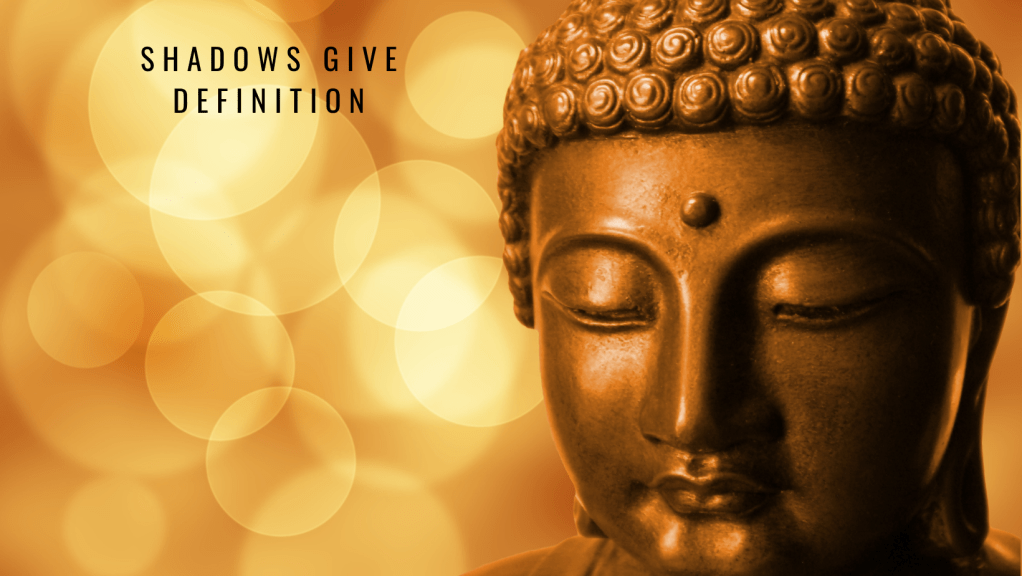
As I sat looking at a statue of Buddha, his head and torso came into focus once the background shadow became apparent. The space we occupy appears three dimensional only when light falling on a subject also shows the depths where the light cannot penetrate. Pondering on this interesting phenomenon, I recalled my illustration classes in Art School, where drawing with a charcoal pencil required my focus to be on the shading. which created the depths, allowing the paper to provide the highlights to complete the picture. Isn’t it fascinating that the positive aspects in anything, are meaningless until the negative is included?
Cleaning out a layer of dust or dirt from an object can sometimes leave traces in the crevices. This can enhance and define the beauty of an object. Similarly, a portrait of an older person is often more interesting, when it shows marks of laughter, pain, age and wisdom that denotes depths to their character, of a life well lived.
I cannot ever remember taking kindly to being shown any of my flaws! However, either I can make an effort to overcome these, or, not consider them as negatives and so accept these aspects as part of my rounded personality. Often, I find that a character becomes worthy of our interest, when he/she has some deeper tones along with the higher traits. In other words, our flaws are as valid as our talents, so would it not be a good idea to own all of ourselves? It is worth acknowledging, that the darker tones in a painting are really a mixture of many different colours that are quite vibrant when seen in isolation.
 Blinding Truths
What an interesting concept!
LikeLike
Hmmmm lovely something to ponder on!
LikeLike